 Zero
オーストラリア太陽光パネルリサイクル市場規模、シェア、成長率および分析レポート(2026年~2034年)
The market size is projected to reach US$4.01 billion in 2025, US$4.64 billion in 2026, and US$11.6 billion by 2034. The compound annual growth rate (CAGR) from 2026 to 2034 is 12.15%
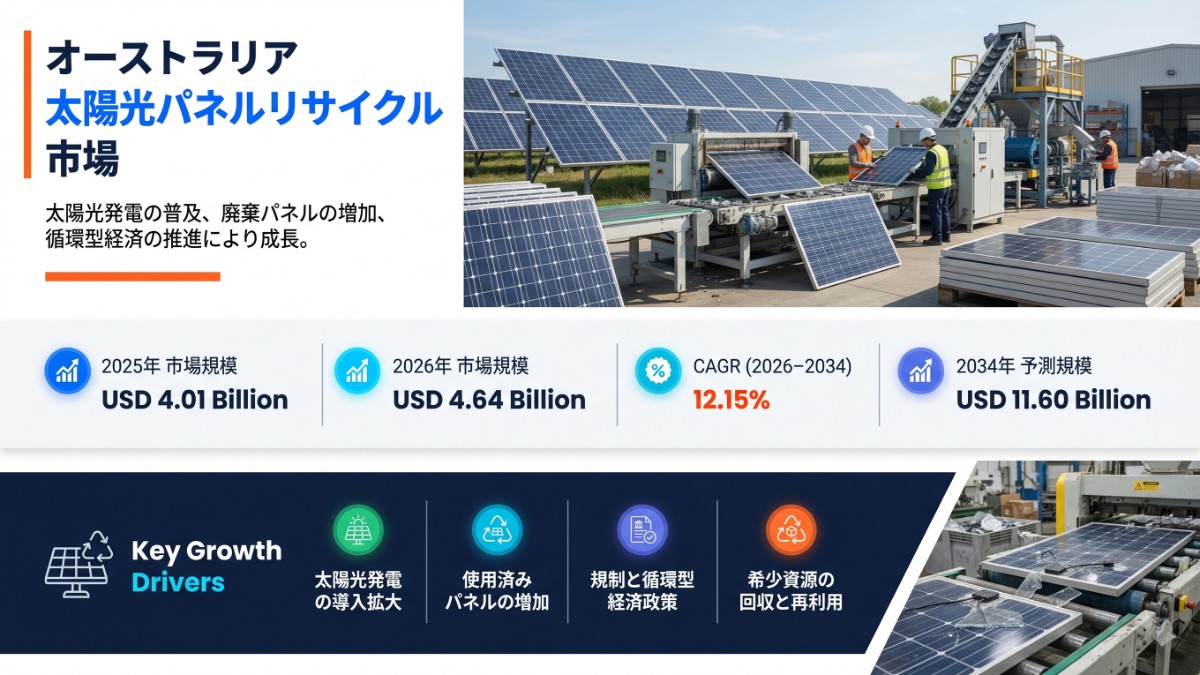
The Australian solar panel recycling market is growing very rapidly due to the increasing number of used panels, stricter landfill and electronic waste regulations in multiple states, enhanced collaboration among recyclers, manufacturers, and research institutions, and advancements in material recovery technologies. The market size is projected to reach US$4.01 billion in 2025, US$4.64 billion in 2026, and US$11.6 billion by 2034. The compound annual growth rate (CAGR) from 2026 to 2034 is 12.15%, and the combined recovered materials, including mechanical, thermal, and laser recycling processes, crystalline silicon and thin-film panels, metals, glass, aluminum, and silicon, are shaping the market share and outlook for the Australian solar panel recycling market by 2034.
For a detailed market analysis, please request a sample report: https://www.imarcgroup.com/australia-solar-panel-recycling-market/requestsample
Market Overview
- By 2025, machining processes are expected to account for approximately 46.8% of the market share, followed by thermal processing at approximately 31.4%, laser processing at approximately 12.6%, and other processes at approximately 9.2%. Laser processing is the fastest-growing process, with a compound annual growth rate (CAGR) of approximately 13.6% from 2026 to 2034.
- Looking at the data by type, crystalline silicon panels account for approximately 84.7% of the market share, followed by thin films at approximately 11.6%.
- The Australian Capital Territory and New South Wales are projected to account for approximately 36.9% of the market share by 2025, making them the top-selling regions.
- The Australian Centre for Advanced Photovoltaics at the University of New South Wales in Sydney estimates that the cumulative amount of used solar panels could reach 1 million tons by 2035.
- Victoria banned landfill disposal of solar panels in July 2019, South Australia and the Australian Capital Territory introduced restrictions on the disposal of electronic waste, and Western Australia began electronic waste regulations in July 2024.
- Australia opened its first research center dedicated to solar panel recycling in April 2026.
- High initial investment, inconsistent processing standards, and dispersed collection and distribution remain the main constraints.
- The market is segmented across five regions of Australia by process, type, material, shelf life, and region, with forecasts provided from 2026 to 2034.
Market growth drivers
Increased demand for used product panels
Australia boasts one of the world's highest rates of rooftop solar power installation, and the early installed panels are now reaching the end of their lifespan. By 2035, the cumulative volume of used panels could reach 1 million tons, becoming an increasingly significant resource source for recyclers.
Landfill ban and electronic waste regulations
Victoria's landfill ban implemented in 2019, electronic waste regulations in South Australia and the Australian Capital Territory (ACT), and the regulations to be implemented in Western Australia from July 2024 are encouraging panel owners and installers to recycle. Clear rules will increase confidence in recycling companies to invest.
Collaboration and Research
Recyclers, manufacturers, and research institutions are collaborating to improve processes and build supply chains. The first dedicated solar panel recycling research center, scheduled to open in April 2026, will further strengthen this ecosystem.
Recovery Technology
Advances in mechanical, thermal, and laser-based recovery technologies have improved material yield and efficiency, making it possible to recover larger quantities of glass, aluminum, silicon, and metals with higher purity and value.
Porter's Five Forces Analysis
Intensity of competition: Moderate
- A small number of large companies with multiple locations are competing with locally-based and specialized recycling companies in terms of processing capacity, collection rates, and collection areas.
- A moderate level of concentration means that competition is focused on securing the supply of panels and contracts.
Electricity supply: Medium to high
- Recyclers rely on a stable supply of used panels from installers, solar power plants, and private homes, making the securing of raw materials extremely important.
- Collection partners and logistics companies have a significant influence.
Purchasing power: Moderate
- Buyers of recycled glass, aluminum, silicon, and metals can choose from multiple suppliers, with prices determined by quality and stability.
- While panel owners and installers can choose their recycling companies, regulations limit their options.
Threat from substitutes: Low
- While landfill restrictions in some states and recycling is becoming increasingly regulated, the reuse and refurbishment of panels can slow down the recycling process.
Threat of new entrants: Moderate
- While funding needs, technical expertise, and collection networks can be barriers, increasing grants and collection volumes are attracting new entrants and research-driven startups.
Market segmentation
Process insights
- mechanical
- hot
- laser
- others
Type Insight
- Crystalline silicon
- Thin film
- others
Material Insight
- Metal
- glass
- aluminum
- silicon
- others
Considerations regarding expiration dates
- Normal loss
- Early defeat
Regional Analysis
- Australian Capital Territory and New South Wales
- Victoria and Tasmania
- Queensland
- Western Australia
- Northern Territory and South Australia
Regional analysis
Australian Capital Territory and New South Wales: This region has the highest concentration of used panels and is a major area where significant recycling investments are being made, including advanced facilities such as the Surcel facility in Parkes, New South Wales.
Victoria and Tasmania: Victoria's landfill ban and state mandates ensure a steady supply of panels to recyclers, with companies like Melbourne-based Lotus Recycling meeting the market needs.
Queensland: The expansion of solar power and processing capacity is clearly demonstrated by Pan Pacific Recycling's dedicated plant, which began operations in October 2024 and processes approximately 240,000 panels annually.
Western Australia: A burgeoning market with developing infrastructure and expanding collection networks, its growth is accelerating with the implementation of e-waste regulations in July 2024 and funding for recycling promotion in Western Australia. Collins Recycling is based in the Perth region, which is seen as a significant growth opportunity.
Northern Territory and South Australia: While awareness and logistics are still developing, and long-distance and small-volume shipments pose challenges to collection, the region is seen as having opportunities for gradual growth.
Competitive environment
The Australian solar panel recycling market is moderately concentrated, with major operators building multi-state facility networks and regional specialists serving local markets. Competition is driven by processing capacity, recovery rates, recovery coverage, technology, and regulatory compliance. Direct consolidation is not anticipated, and growth will primarily be driven by new facilities, funding, and partnerships.
The main players are as follows:
- Sarcel Limited: A market-leading company with multiple locations in New South Wales, Queensland, and Victoria.
- PV Industries: A market-leading company with a nationwide network spanning multiple cities.
- Pan Pacific Recycling: A strong competitor and a Queensland-based large-scale recycling operator.
- Lotus Recycle: A challenger based in Victoria.
- Collins Recycling: A challenger targeting the Perth metropolitan area.
Recent Industry Trends
November 2026: The Australian government has terminated the procurement process for the A$24.7 million nationwide solar panel recycling pilot project, failing to reach a contract. This decision comes after a six-month suspension of the project and a review of changes in the recycling industry. The government is now considering the future direction of the national project, which aims to collect and recycle up to 250,000 solar panels.
October 2026: RMIT University and the RAND Institute published a report warning that Australia could accumulate more than one million tons of used solar panels by 2035. The study recommends establishing a nationwide market for reusable panels, implementing product management systems, and strengthening commercial recycling infrastructure to recover valuable materials.
September 2026: The New South Wales government has begun discussions on Australia's first mandatory solar panel recycling scheme. The proposed regulations would require solar panel brand owners to take responsibility for collecting, recycling, and recovering the resources from used panels. New South Wales currently generates approximately 14,000 tons of solar panel waste annually, which could increase to 89,000 tons by 2045.
August 2026: The Western Australian government has launched the A$13 million "Remade in WA" program to establish a collection and recycling route for solar panels. This initiative includes an industry baseline assessment to explore collection logistics, repair and refurbishment opportunities, recycling infrastructure, and investment requirements to support the local solar panel recycling industry.
Key aspects required for the Australian solar panel recycling market
- Market performance: The market size is projected to reach US$4.01 billion in 2025, US$4.64 billion in 2026, and US$11.6 billion by 2034.
- Market Outlook: The compound annual growth rate (CAGR) of 12.15% from 2026 to 2034 reflects the expectation of very rapid expansion as the number of panels being phased out increases and regulations become stricter.
- The drivers of growth: the increase in used panels, landfill bans and electronic waste regulations, collaboration and research, and recovery technologies.
- Competitive Landscape: Sircel Limited and PV Industries lead the industry through their facility networks, while PanPacificRecycling, Lotus Recycling, and Collins Recycling are strong competitors.
- Industry trends: lasers and advanced recovery methods, specialized research centers, new national regulations, and larger-scale processing plants.
- Strategic recommendations: Invest in higher-yield recovery technologies, build a nationwide recovery network, comply with state regulations, and establish partnerships with research institutions and manufacturers.
Note: If you require specific information not included in the report, we can provide it as part of a customization.
Consult an analyst: https://www.imarcgroup.com/request?type=report&id=34498&flag=C
FAQ
1. What is the size of the solar panel recycling market in Australia?
The market size is projected to reach US$4.01 billion by 2025 and US$11.6 billion by 2034.
2. What is the projected growth rate of the Australian solar panel recycling market?
The market is projected to grow at a compound annual growth rate (CAGR) of 12.15% from 2026 to 2034.
3. What are the factors driving the growth of the Australian solar panel recycling market?
The driving forces behind this growth are the increasing number of used panels, regulations concerning landfills and electronic waste, collaboration between recyclers and research institutions, and advancements in recovery technology.
Zero Press のデータで見るこのリリース
- 配信元
- Arlo Bennett(Zero Press 掲載 2 本)
- 配信
- Zero Press から配信
- カテゴリ
- 調査・レポート
- 直近 7 日の配信
- 調査・レポート 1,333 本 / 全体 10,667 本
Zero Press が取り込んだ配信データから自動集計しています。カテゴリ別・業界別のより詳しい分析は週間動向レポートで毎週公開しています。
このジャンルのリリースを書くときのガイド

このリリースの配信元
Arlo Bennett
企業概要・過去のリリース・提供資料は企業ページでご覧いただけます。
-

北米のミューチュアルファンド:市場シェア分析、産業動向・統計データ、成長予測(2026年~2031年)
株式会社グローバルインフォメーション
-
欧州のアロマテラピーディフューザー:市場シェア分析、業界動向と統計、成長予測(2026年~2031年)
株式会社グローバルインフォメーション
-
エラストマー膜:市場シェア分析、業界動向と統計、成長予測(2026年~2031年)
株式会社グローバルインフォメーション
-

男女問わず大助かり!95.7%が実感する「手荒れ」を 解決するアトリエはるかの時短ハンドケア術とは ~男女ともに受けられる爪まわり・手肌ケア。 ハンドパック5枚購入で1枚無料キャンペーンを 12月31日まで実施中~
株式会社アトリエはるか
-

焼結ネオジム磁石の世界市場(2026年~2032年)、市場規模(Mタイプ、Hタイプ、SHタイプ、その他)・分析レポートを発表
株式会社マーケットリサーチセンター
-

車載POS端末の世界市場(2026年~2032年)、市場規模(クアッドコア、オクタコア、その他)・分析レポートを発表
株式会社マーケットリサーチセンター
-

「家族なんだから」が、助けを求める声を奪っていく。累計約4万人の相談に携わってきた臨床心理士・神崎肖子が、家族危機の知られざる現実を語る講演会を開催
神崎肖子
-
UK Corporate Wellness Market Size, Share, Trends and Outlook 2034
Rahul
-

U-KWON、ONE PACT、8TURNらが出演 「LIVE : DO YOUR BEST Vol.03」を12月20日に開催
株式会社MOREDAY
-

鮮やかな紅色と濃厚な甘みの香川県産みかん「金時紅」を「JAタウン」で販売開始!
JA全農の産直通販JAタウン
-

「このままの人生でいいのか?」生き方を変えたいときに読む10のヒント──米山公啓著『人生を変えたクルーズ船の10日間』新版刊行
LongTail Books
-

「ゼルダの伝説」シリーズ 一番くじの最新作が12月5日(土)より登場!
株式会社BANDAI SPIRITS ロト・イノベーション事業部