 Zero
オーストラリアの保育サービス市場規模、シェア、成長率、予測レポート(2026年~2034年)
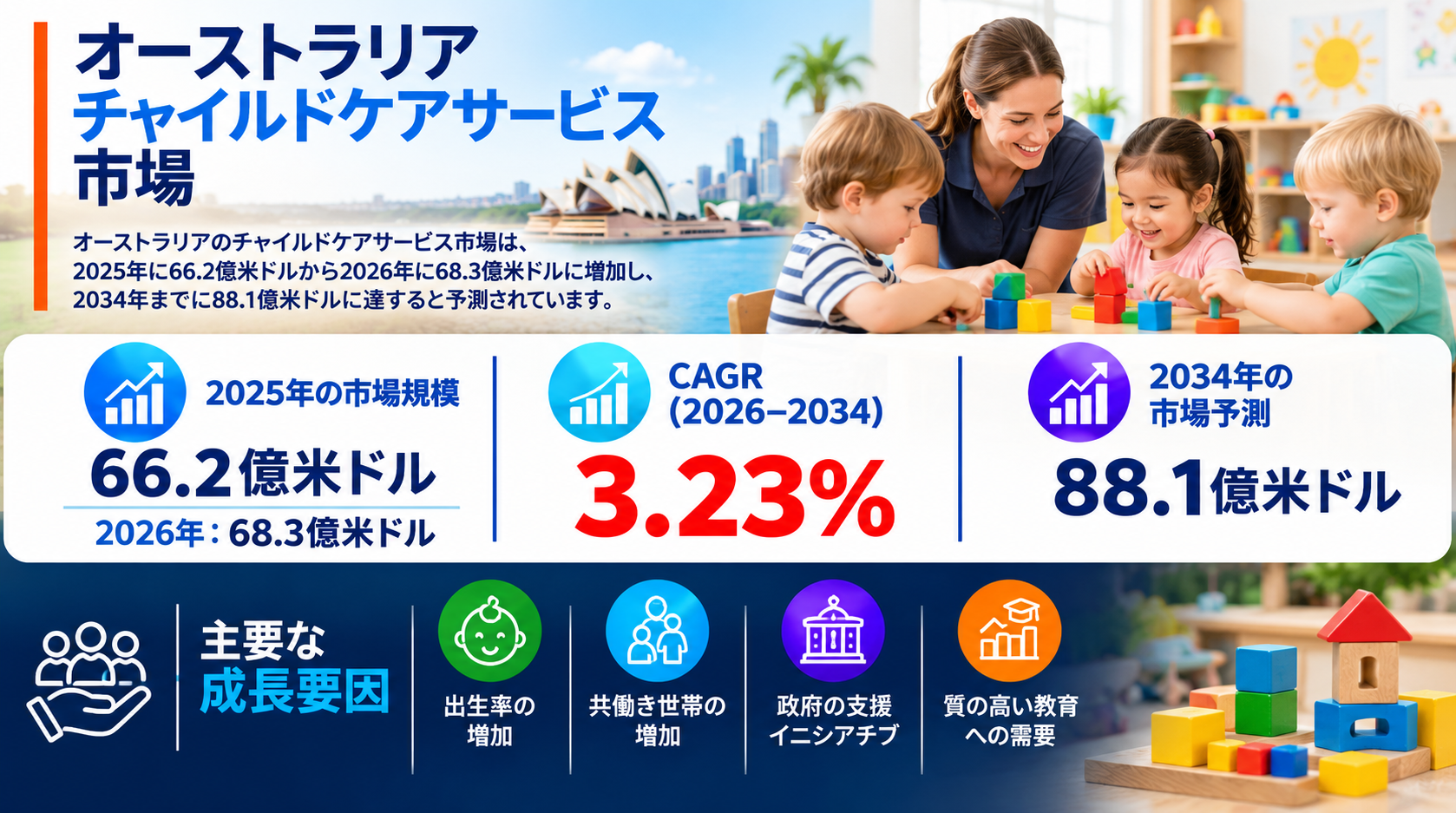
オーストラリアの保育サービス市場は、女性の労働参加率の高さ、政府による保育補助金、幼児教育に対する親の関心の高まり、共働き世帯の増加、都市生活の拡大などに支えられ、着実に成長しています。市場規模は2025年に66億2000万米ドルに達し、2026年には68億3000万米ドルと推定され、2034年には88億1000万米ドルに達すると予測されています。2026年から2034年までの年平均成長率(CAGR)は3.23%で、センター型保育と家庭型保育、幼児教育、幼児保育、幼児ケアサービスなど、2034年までのオーストラリアの保育サービス市場のシェアと見通しを形成しています。
Market overview
The Australian childcare services market is growing steadily, supported by high female labor force participation, government childcare subsidies, increasing parental interest in early childhood education, a rise in dual-income households, and the expansion of urban life. The market size is projected to reach US$6.62 billion in 2025, US$6.83 billion in 2026, and US$8.81 billion in 2034. The compound annual growth rate (CAGR) from 2026 to 2034 is 3.23%, and this growth will shape the market share and outlook for the Australian childcare services market up to 2034, including centralized and home-based childcare, early childhood education, early childhood care, and early childhood care services.
For a detailed market analysis, please request a sample report: https://www.imarcgroup.com/australia-child-care-services-market/requestsample
Market Summary
- By 2025, the female labor force participation rate is expected to exceed 62.5%, the highest level in the Asia-Pacific region, and demand for reliable childcare services is projected to remain strong.
- Government subsidies reduce the out-of-pocket expenses for eligible families and expand access to formal care services.
- By 2025, center-based care is projected to account for approximately 88.6% of the market, boasting an overwhelming market share, while home-based care will account for approximately 11.4%, growing at a pace exceeding the overall market growth rate.
- Early childhood education and childcare topped the market with approximately 55.8% of the share, followed by childcare at approximately 28.7%, with backup care being the fastest-growing subsegment.
- The Australian Capital Territory and New South Wales hold the top spot with approximately 36.8% of the regional share, while the Northern Territory and South Australia have the smallest share at 5.4%, but are the fastest-growing regions.
- The main constraints are a shortage of educators, the high cost of providing quality care, and inadequate local infrastructure.
- The market is segmented by delivery type, category, and region across five regions of Australia, with forecasts provided from 2026 to 2034.
Market growth drivers
High rate of female labor force participation
By 2025, the female labor force participation rate is expected to exceed 62.5%, and many families rely on public childcare services to balance work and family life. With the increase in dual-income households and longer working hours, there is a growing need for full-day childcare and flexible options that accommodate diverse work arrangements.
Government childcare subsidies
Government subsidies reduce the out-of-pocket expenses for eligible families, make public services more accessible, and encourage participation in both childcare and early childhood education. Subsidy programs have a significant impact on demand and how service providers plan their capacity and pricing.
The growing appreciation for early childhood education
Among parents, there is a growing trend to view early childhood education as crucial for school preparation and long-term development. This trend is increasing the demand for services that combine childcare with systematic learning, supporting the leading position of early childhood education and childcare facilities.
Urbanization and dual-income households
With the increase in urban populations and the rise in dual-income households, there is a growing demand, particularly in metropolitan areas, for full-day childcare services that can be used close to home or work.
Market constraints and challenges
- High-quality medical care comes at a high cost: high fees may limit access for low-income families who do not receive sufficient subsidies.
- Teacher shortages and retention rates: Securing and retaining excellent educators is particularly difficult in rural and rural areas.
- Infrastructure gaps: In rural and remote communities, healthcare facilities often have limited capacity, and care options are limited.
- Evolving quality and regulatory standards: Raising standards increases the operating costs for providers.
- Fluctuations in enrollment: Fluctuations in visitor numbers make it difficult to manage the utilization rate of the venue's capacity.
Market opportunities
- Flexible, home-based care: Subsidized, flexible home-based care models can accommodate families who need services at different times and locations, and home care is already expanding at a pace that exceeds the overall market growth rate.
- Technology Platform: By utilizing digital tools for admissions, grant applications, and communication with parents, efficiency can be improved and parent satisfaction can be increased.
Porter's Five Forces Analysis
Intensity of competition: Moderate to high
- Large national operators, non-profit organizations, and many independent centers compete on factors such as location, quality ratings, fees, and educational programs.
- Brand reputation, instructor quality, and center location are important differentiating factors.
Power supply: medium to high
- Qualified educators are the most important element, and a shortage of educators has a strong impact on costs for workers and the labor market.
- Property owners and landlords also have an impact on costs through rents in the city center.
Purchasing power: moderate
- While families can compare and change childcare facilities, in many areas, their options are limited by waiting lists and location restrictions.
- Government subsidy regulations affect how much each household pays and how they choose to receive them.
Threat from substitutes: Moderate
- Informal care provided by relatives, babysitters, and in-home services can be an alternative to care in formal childcare facilities.
- Flexible work arrangements can reduce the number of days of care needed by some families.
Threat of new entrants: Moderate
- Licensing systems, quality standards, and staffing requirements can be barriers, but individual centers and home-based services can enter local communities.
- Measuring instrument manufacturers benefit from brand, system, and purchasing advantages.
Market segmentation
Considerations regarding delivery types
- Center Base: Expected to capture approximately 88.6% of the market share by 2025.
- Remote work: It is expected to capture approximately 11.4% of the market share by 2025, outpacing the overall market growth rate.
Type Insight
- Early childhood education and care: Expected to capture approximately 55.8% of the market share by 2025.
- Early care: Expected to account for approximately 28.7% of the market share by 2025.
- Backup Care: The fastest-growing subsegment by type.
Regional Analysis
- Australian Capital Territory and New South Wales
- Victoria and Tasmania
- Queensland
- Northern Territory and South Australia
- Western Australia
Regional analysis
The Australian Capital Territory and New South Wales (approximately 36.8%) are the largest markets in the region, supported by Sydney's large population and high population density, high female labor force participation, and strong demand for full-day childcare with an emphasis on education. Canberra's public sector workforce also supports a steady demand for reliable childcare services.
Victoria and Tasmania (approximately 26.9%): Melbourne has a large young family population and a strong emphasis on early childhood education, resulting in robust demand, while smaller communities in Tasmania are more reliant on locally-based services.
Queensland (approximately 20.7%): In southeastern Queensland, rapid population growth, interstate migration, and suburban expansion are driving demand for new centers, while rural areas face challenges in terms of capacity and labor.
In Western Australia (approximately 10.2%) , demand in urban areas of Perth is supported by income from the resource industry and dual-income households, while flight-in/flight-out work arrangements are driving demand for flexible and emergency care.
Although the Northern Territory and South Australia (approximately 5.4%) have the smallest share, they are the fastest-growing region, supported by population growth and a expanding workforce in Adelaide and Darwin. Remote communities face a lack of infrastructure and educators, making flexible, home-based learning models particularly important.
Competitive environment
Australia 's childcare services market is a growing landscape , with large national operators coexisting with non-profit organizations, local businesses, and numerous independent service providers. Competition is driven by quality ratings, educator capabilities, location, pricing, and the ability to expand operations in growth sectors.
- G8 Education Limited
- Good Start Early Learning
- University of Kansas Children's Services
- Busy Bees Australia Holding Pty Ltd
- Camp Australia
Recent Industry Trends
Network Quality and Growth: Leading operators such as G8 Education and Goodstart Early Learning continue to focus on improving the quality of their central networks and expanding capacity in areas with the highest demand.
Educator training: Educational institutions are prioritizing the recruitment, training, and retention of educators, particularly given the shortage of talent in rural areas.
Comprehensive Services: Operators, including KU Child Services, prioritize comprehensive and accessible early childhood education and care services to meet the diverse needs of families.
Flexible after-school care: Providers like Busy Bees Australia and Camp Australia are driving the demand for flexible after-school care models that are suitable for working families.
Key aspects required for the Australian childcare services market
- Market performance: The market size is projected to reach US$6.62 billion in 2025 and reach US$8.81 billion by 2034, driven by labor force participation rates, subsidies, and demand for early childhood education.
- Market Outlook: The compound annual growth rate (CAGR) of 3.23% from 2026 to 2034 reflects steady expansion supported by policy-making and population growth.
- The driving forces behind this growth include a high rate of female labor force participation, government subsidies, a focus on early childhood education, urbanization, and an increase in dual-income households.
- Competitive landscape: G8 Education, Goodstart Early Learning, and KU Children's Services are the leaders, with Busy Bees Australia and Camp Australia listed as challengers.
- Industry trends: Expansion of in-home and backup childcare, utilization of technology platforms for registration and subsidy applications, and a focus on educator training and inclusive services.
- Strategic Recommendations: Invest in recruiting and retaining educators, expand flexible work arrangements and remote work options, leverage technology to improve the parent experience and efficiency, and focus on supporting rapidly growing areas and underserved communities.
Note: If you require specific information not included in the report, we can provide it as part of a customization.
Consult an analyst: https://www.imarcgroup.com/request?type=report&id=21973&flag=C
FAQ
1. What is the size of the childcare services market in Australia?
The market size is projected to reach US$6.62 billion in 2025, US$6.83 billion in 2026, and US$8.81 billion in 2034.
2. What is the projected growth rate of the Australian childcare services market?
The market is projected to grow at a compound annual growth rate (CAGR) of 3.23% from 2026 to 2034.
3. What are the factors driving the growth of the Australian childcare services market?
The driving forces behind this growth are the high rate of female labor force participation, government subsidies for childcare, increased parental interest in early childhood education, the rise in dual-income households, and the progress of urbanization.
Zero Press のデータで見るこのリリース
- 配信元
- Arlo Bennett
- 配信
- Zero Press から配信
- カテゴリ
- 調査・レポート
- 直近 7 日の配信
- 調査・レポート 1,331 本 / 全体 10,378 本
Zero Press が取り込んだ配信データから自動集計しています。カテゴリ別・業界別のより詳しい分析は週間動向レポートで毎週公開しています。
このジャンルのリリースを書くときのガイド

このリリースの配信元
Arlo Bennett
企業概要・過去のリリース・提供資料は企業ページでご覧いただけます。
-

アルミニウム顔料:市場シェア分析、業界動向と統計、成長予測(2026年~2031年)
株式会社グローバルインフォメーション
-
輸液管理:市場シェア分析、業界動向と統計、成長予測(2026年~2031年)
株式会社グローバルインフォメーション
-
細胞毒性薬:市場シェア分析、業界動向と統計、成長予測(2026年~2031年)
株式会社グローバルインフォメーション
-

ICチップ用レーザーマーキング機の世界市場(2026年~2032年)、市場規模(ファイバーレーザー、UVレーザー、CO2レーザー)・分析レポートを発表
株式会社マーケットリサーチセンター
-

導管内水力発電機の世界市場(2026年~2032年)、市場規模(インパルス水車、リアクション水車、クロスフローおよびスクリュー水車、インラインラジアル水車)・分析レポートを発表
株式会社マーケットリサーチセンター
-

耐火建材の世界市場(2026年~2032年)、市場規模(不燃材料、限定燃焼材料、難燃材料)・分析レポートを発表
株式会社マーケットリサーチセンター
-

【12月20日まで】RecoveryFox AIの30日間ライセンスを無料配布
WonderFox Soft, Inc.
-

朝の血圧が高い。その原因を「昼間」だけ考えていませんか?眠っている間の呼吸と自律神経という生理学的視点
トラタニ株式会社
-

東京・大阪の直営飲食店舗で「佐賀県産 和牛とお米のフェア」を12月1日(火)より開催
みのりみのるプロジェクト
-

京都 宇治の老舗 辻利(TSUJIRI)より、冬季限定メニュー 「辻利ソフト 冬のパルフェ」「京ラテ®濃い茶ショコラ」「京ラテ® ほうじ茶」「はちみつ柚子グリーンティー」 2026年12月1日(火)~2027年2月15日(月)期間限定発売
片岡物産
-

【名城大学】ポリフェノール類の「シス化」で水と油への溶解度が劇的に向上
学校法人 名城大学
-

数量限定!「ナゲッツ★十勝カマンベール」 2026年11月27日(金)新発売!
ミニストップ株式会社