 Zero
ラテンアメリカのモバイル決済市場規模、シェア、レポート(2026年~2034年)
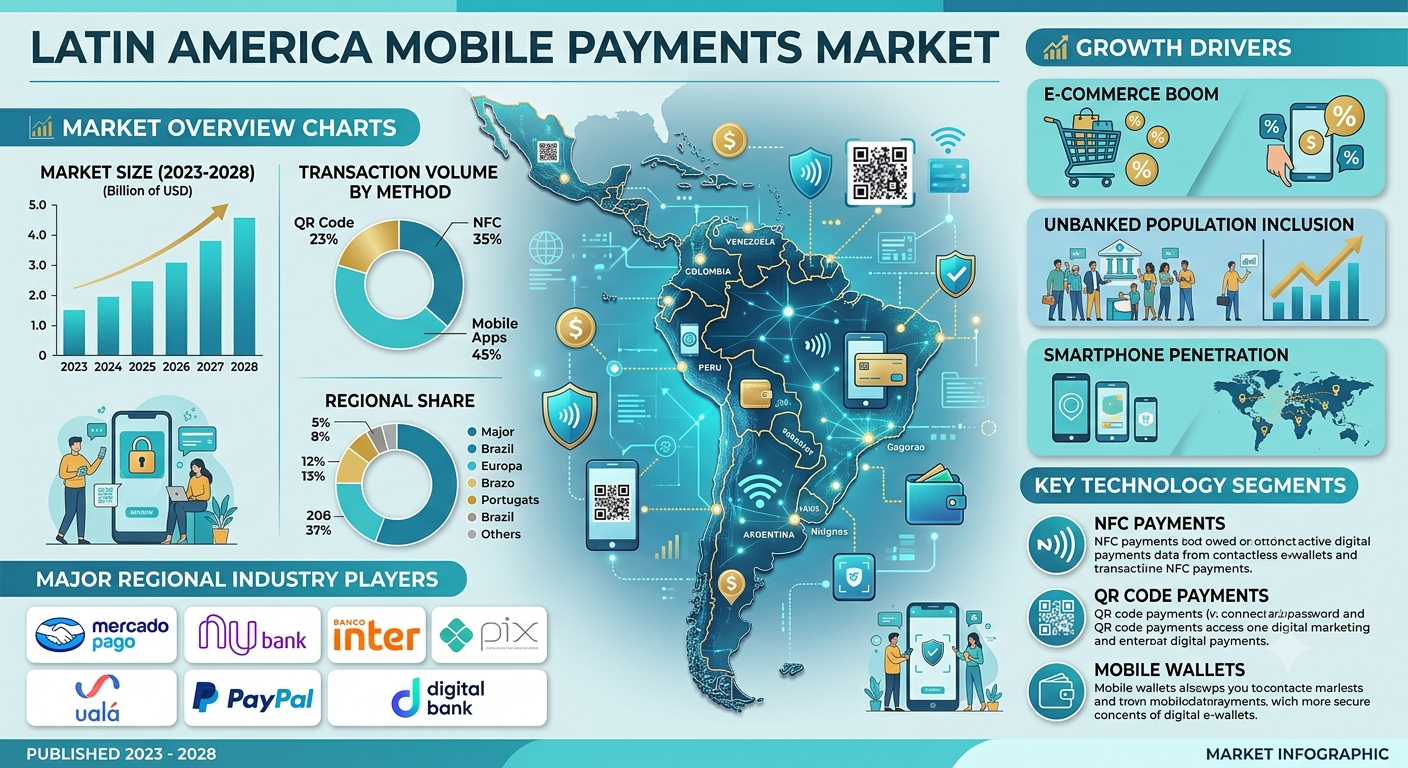
の ラテンアメリカのモバイル決済市場規模2025年には3,709億米ドルに達しました。今後、IMARCグループは、2026年から2034年の間に年平均成長率(CAGR)19.17%で成長し、2034年までに1兆8,794億米ドルに達すると予測しています。PixやBre-Bなどの即時決済システム、デジタルウォレットやネオバンクの台頭、スマートフォンの高い利用率、QRコードの受け入れ、eコマースと加盟店のデジタル化の成長が、2034年までのラテンアメリカのモバイル決済市場のシェアと見通しを形成しています。モバイル決済は、金融包摂のためのツールから、地域全体の中核的な金融インフラへと移行しています。
Market Overview
The Latin American mobile payments market reached US$370.9 billion in 2025. Looking ahead, the IMARC Group projects that it will grow at a compound annual growth rate (CAGR) of 19.17% between 2026 and 2034, reaching US$1,879.4 billion by 2034. Instant payment systems such as Pix and Bre-B, the rise of digital wallets and neobanks, high smartphone usage, QR code adoption, and the growth of e-commerce and merchant digitalization are shaping the Latin American mobile payments market share and outlook by 2034. Mobile payments are shifting from a tool for financial inclusion to a core financial infrastructure across the region.
Market Overview
Pix has reached enormous scale. By January 2026, Pix Brazil will surpass 7 billion transactions per month and have more than 170 million individual users.
Commercial use is increasingly surpassing peer-to-peer use. In Brazil, by March 2026, Pix transactions between individuals and businesses are projected to reach 3.09 billion, exceeding peer-to-peer transactions.
Colombia is seeing faster adoption than Brazil. Colombia's Bre-B gained 36 million active users in its first year of service, becoming the fastest-growing instant payment method in Latin America.
Electronic wallets are becoming mainstream. According to a report by Euromonitor, by 2024, 60% of consumers in Latin America will use smartphone payments at least once a month for in-person transactions.
Government-led systems are growing at a faster pace. In Brazil and Mexico, the number of electronic money transfer transactions increased by an average of 81% annually from 2021 to 2023, compared to only 48% in other Latin American countries.
Fast payments are driving the increase overall in digital usage. According to a World Bank report, digital payments per account holder are surging across Latin America and the Caribbean, with 61% of that increase attributed to fast payment systems.
Cash hasn't disappeared. Observers point out that Pix, Bre-B, and SPEI are transforming the way transactions are conducted without replacing cash.
The market is segmented by type (remote payment and proximity payment), application, and country, with forecasts provided from 2026 to 2034.
Market growth drivers
Government-supported instant payment system
Public instant payment systems have changed consumer expectations. Pix, launched by the Central Bank of Brazil, offers 24/7 real-time money transfers at low fees or for free, while Colombia's Bre-B emulated Brazil's success, becoming used by approximately 83% of the country's adults within a year. In Mexico, about 6 out of 10 people use SPEI, and CoDi added QR code and NFC technology to its POS payments in 2019. Because these systems are interoperable between banks and apps, they reduce the friction that had previously hindered the adoption of digital wallets and provide merchants with a low-cost alternative to cards. The Central Bank of Brazil is also linking digital payments to everyday retail by adding features such as cash withdrawals and change at stores.
Digital wallets, neobanks, platform ecosystems
Personal wallets and digital banks are the main drivers. Mobile wallets have become the preferred payment method in Argentina, Colombia, and Mexico, with apps like Mercado Pago, Nubank, and PicPay storing cards and offering a variety of financial services. Nubank alone processes over 2 billion Pix transactions per month in Brazil, which accounts for about one-third of the total for Brazil. In other markets, privately-driven systems are becoming more important, such as Daviplata and Nequi in Colombia, and Yape and Plin in Peru. eMarketer points out that financial services are shifting to a mobile multi-rail ecosystem, and as platforms own their customers, banks are being forced to choose between being integrated into the transaction flow or blending into the background.
E-commerce, merchant digitalization, cross-border access
The digitalization of online shopping and small businesses is driving an increase in mobile payment transaction volume. Colombia's digital commerce market is estimated at US$59 billion and is projected to reach US$73 billion by 2028, with merchants worldwide increasingly embracing local payment methods to reach consumer consumers without cards. In July 2026, ACI Worldwide and dLocal announced a partnership that will allow merchants worldwide to access Pix, PicPay, Mercado Pago, OXXO, SPEI, and other leading local payment methods in Brazil and Mexico through a single integration. Argentina, Chile, Colombia, and Peru are also planned. Merchants are also planning to use digital wallets and mobile payment tools to improve cash flow visibility and reduce payment delays.
For a detailed market analysis, please request a sample report: https://www.imarcgroup.com/latin-america-mobile-payment-market/requestsample
Porter's Five Forces Analysis
Intensity of competition: High
Digital banks, wallet providers, traditional banks, payment processors, and global technology companies are all competing for users and merchants.
Free or low-cost instant payment systems are putting pressure on card and wallet fees and shifting competition towards credit, loyalty, and value-added services.
User experience, reliability, merchant acceptance, and the breadth of the ecosystem are key differentiators.
Demand power: moderate
Central banks manage the core infrastructure for instant settlements, and therefore have strong influence over rules, pricing, and access.
Mobile phone operators, device manufacturers, and cloud and security providers are providing essential infrastructure.
Payment orchestration providers and processors help merchants connect to multiple local payment methods, reducing their reliance on a single supplier.
Buyer's bargaining power: High
Consumers can easily switch between apps, banks, and payment methods, and many people use multiple methods simultaneously.
Merchants can choose from options such as card payments, e-money payments, QR code payments, and instant payments, and negotiate fees with payment processors.
Free instant payment increases consumers' expectations for low or free services.
Threat from substitutes: Moderate
Cash, cards, and bank transfers continue to compete with mobile payments, especially for small and informal transactions.
Stablecoins and other digital assets are being promoted as alternatives to cross-border remittances.
The convenience, speed, and low cost of mobile payments and instant payments continue to encourage people to switch their payment methods.
Threat of new entrants: Moderate
Open systems and interoperability lower the barriers to entry for fintech companies and new wallet providers into the market.
Regulatory approvals, security requirements, and the need to build user trust and a merchant network all contribute to increased costs.
Existing platforms have advantages in terms of user base, data, and ecosystem services.
Market segmentation
Type Insight
Remote payment
Proximity payment
Application Insights
Retail and e-commerce
Entertainment
health care
Hospitality and Travel
others
Country Information
Brazil
Mexico
Argentina
Colombia
Chile
others
further research
Brazil: Brazil is the largest and most advanced market in the region, driven by leading digital banks and wallets, including Pix, which boasts over 170 million users and billions of transactions per month. Pix is increasingly being used for commercial payments, with retailers leveraging it for their daily retail and online sales.
Mexico: Mexico boasts one of the largest fintech ecosystems in the region, with SPEI widely used and CoDi supporting QR code and NFC payments. The market is characterized by strong growth in digital payments and a high rate of cash usage, particularly for small transactions.
Argentina: A digital wallet culture is deeply ingrained in Argentina, with Mercado Pago being a household name, and wallets surpassing credit cards in some e-commerce. Instant payment systems like Transferencias 3.0 support everyday payments, and the economic situation is also driving the use of digital payments and alternative payment methods.
Colombia: The Bre-B system has rapidly gained popularity in Colombia, with 83% of adults using it in its first year. Nequi and Daviplata were early adopters of digital payments, and the interoperability of Bre-B is creating new opportunities for merchants worldwide.
Chile: Chile has a highly developed banking system, and digital wallets and card-linked mobile payments are widely used. The central bank is developing its own instant payment solutions as part of its strategic plan, and domestic fintech companies and global wallet companies are competing to acquire users.
Other markets include Peru, Uruguay, Ecuador, and Central America. In Peru, Yape and Plin are the main wallets, while Uruguay has several fintech companies and wallets. In smaller markets, digital payments are expanding through mobile phone operators and banks.
Competitive cuisine
The Latin American mobile payments market includes digital banks, wallet providers, traditional banks, payment processors, and global technology and fintech companies. The competitive landscape is shaped by the integration of instant payments, merchant acceptance, embedded finance and credit, interoperability, regulatory trends, and partnerships with global merchants and platforms. As global companies enter the region, payment orchestration and local acquisition specialists are also growing. This report covers the market structure, key player positioning, success strategies, competitive dashboard, company valuation quadrants, and detailed profiles of key players.
The main players are as follows:
Mercado Pago
Newbank
PICPay
Banking
Yape (BCP)
Neki (Ban Colombia)
dLocal
Banks
Recent Industry Trends
October 2026: According to an analysis released by EBANX, Bre-B in Colombia reached 36 million active users in its first year of service, representing 83% of the country's adult population, and spread at a faster pace than Pix. This result demonstrates how Pix's regional experience is helping to rapidly scale the new system.
July 2026: ACI Worldwide and dLocal announced a partnership in Brazil and Mexico to enable global merchants to use local payment methods, with plans to expand to four more markets. In the same month, an article was published analyzing how regulators in Brazil, Colombia, and Mexico are allowing Pix, Bre-B, and SPEI to coexist with cash.
March 2026: According to data from the Central Bank of Brazil, the number of Pix (person-to-person transfer) transactions in March reached 3.09 billion, exceeding the number of individual person-to-person transfer transactions. This shift indicates that Pix is moving from consumer-to-consumer transfers to everyday commercial transactions.
January 2026: According to reports, Pix processes over 7 billion transactions per month and has more than 170 million individual users. This scale confirms that Pix is a global benchmark in instant payments.
Key elements required for the mobile payment market in Latin America
Market performance: The market size is projected to reach US$370.9 billion in 2025 and then reach US$1,879.4 billion by 2034, driven by the growth of instant payment systems, digital wallets, and e-commerce.
Market Outlook: The compound annual growth rate (CAGR) of 19.17% from 2026 to 2034 reflects the extremely rapid expansion expected as mobile payments become a core infrastructure.
The drivers of growth: government-backed instant payment systems, digital wallets, neobanks, platform ecosystems, and e-commerce, merchant digitalization, and cross-border access.
Competitive Landscape: Mercado Pago, Nubank, PicPay, PagBank, Yape, Nequi, dLocal, and EBANX compete in terms of user base, penetration rate, ecosystem services, and interoperability.
Value Chain Analysis: The value chain extends from central bank payment systems, banks, and mobile phone operators through wallets and fintech providers, payment processors, and payment orchestration platforms to merchants and consumers in Latin American countries.
Industry trends: the rise of instant payment systems, increased use between individuals and businesses, multi-rail ecosystems, the widespread adoption of QR codes and NFC, and coexistence with cash.
Strategic recommendations: Integration with domestic instant payment systems and wallets, development of embedded credit and merchant services, investment in the acceptance of QR codes and NFC, partnerships with orchestration providers for cross-border deployment, and strengthening security and fraud prevention.
Note: If you require specific information not included in the report, we can provide it as part of a customization.
Consult with an analyst: https://www.imarcgroup.com/request?type=report
FAQ
1. What is the size of the mobile payment market in Latin America?
The market size is projected to reach US$370.9 billion in 2025 and US$1.8794 trillion by 2034.
2. What is the projected growth rate of the mobile payments market in Latin America?
The market is projected to grow at a compound annual growth rate (CAGR) of 19.17% from 2026 to 2034.
3. What are the factors driving the growth of the mobile payment market in Latin America?
The growth is being driven by government-backed instant payment systems, digital wallets, neobanks, platform ecosystems, and e-commerce, merchant digitalization, and cross-border access.
About Us
IMARC Group is a global management consulting firm that helps the world's most ambitious changemakers create lasting impact. The company provides comprehensive services for market entry and business expansion. IMARC's services include thorough market assessment, feasibility studies, company formation support, factory setup support, regulatory approval and licensing support, branding, marketing and sales strategies, competitive landscape analysis and benchmarking, pricing and cost analysis, and procurement research.
inquiry
IMARC Group, 134 North 4th Avenue, Brooklyn, New York, USA, 11249 zip code. Email: sales@imarcgroup.com Phone: (D) +91 120 433 0800 United States: +1-631-791-1145
Zero Press のデータで見るこのリリース
- 配信元
- B2B Market Report(Zero Press 掲載 2 本)
- 配信
- Zero Press から配信
- カテゴリ
- その他
- 直近 7 日の配信
- その他 172 本 / 全体 10,378 本
Zero Press が取り込んだ配信データから自動集計しています。カテゴリ別・業界別のより詳しい分析は週間動向レポートで毎週公開しています。
このジャンルのリリースを書くときのガイド
このリリースの配信元
B2B Market Report
企業概要・過去のリリース・提供資料は企業ページでご覧いただけます。
-
Spain Programmable Logic Controller (PLC) Market Size, Share and Report 2034
Rahul
-

相談室の外にいる「助けて」を見逃さないために。臨床心理士・神崎肖子の家族危機介入が英語メディアで紹介
神崎肖子
-

自治体の墓石撤去費用の補助、当サイトの調べで確認できたのは市川・浦安・太田の3市(いずれも市の公営墓地の使用者向け) 改葬は10年で約2.1倍の19万件に|葬儀安心ナビ調べ
ぷれりり掲載リリース
-

投資用ワンルームの手残りを試算 売却時の概算額と月々の収支を確認
株式会社煌海プロパティ
-

おひめさまごっこプロジェクトinアリオ八尾
ぷれりり掲載リリース
-

【HEALTHIER MAGAZINE(ヘルシアマガジン)】24時間年中無休フィットネスジム「エニタイムフィットネス」のウェブマガジン更新中! <巻き肩をケアして、デスクワークの疲れをリセット! 低負荷で始めるケーブルマシントレーニング>
株式会社Fast Fitness Japan
-

料亭や割烹の予約から会計までつなぐ飲食店管理システム「福猫」を11月25日に提供開始
株式会社アドバンスフォート
-

音声ChatGPT搭載家庭用ヒューマノイドロボット「Noetix Boomy」予約受付開始
ぷれりり掲載リリース
-

東京ジャンク Z 年末の下北沢で3年ぶりの本公演 湯煙歌謡劇場『オーバーフロー湯花奇譚』上演決定!
カンフェティ(ロングランプランニング株式会社)
-
【大同大学】「2026年度グッドデザイン・ニューホープ賞」で優秀賞を受賞しました/情報デザイン学科 舟橋研究室
大同大学
-
AIを使う人から、AIを率いる人へ。実務で使うAIオフィスの構築を学ぶ「AXONE.(エーエックスワン)」を開校
MODE-1PARTNERS株式会社
-

2026年11月25日(水)QPS研究所の小型SAR衛星20号機 「ワダツミ-Ⅱ」による初画像(ファーストライト)として、高精細モード画像を公開
株式会社QPS研究所