 Zero
Australia Agricultural Machinery Market Projected to Reach USD 6.5 Billion by 2034
Market Overview
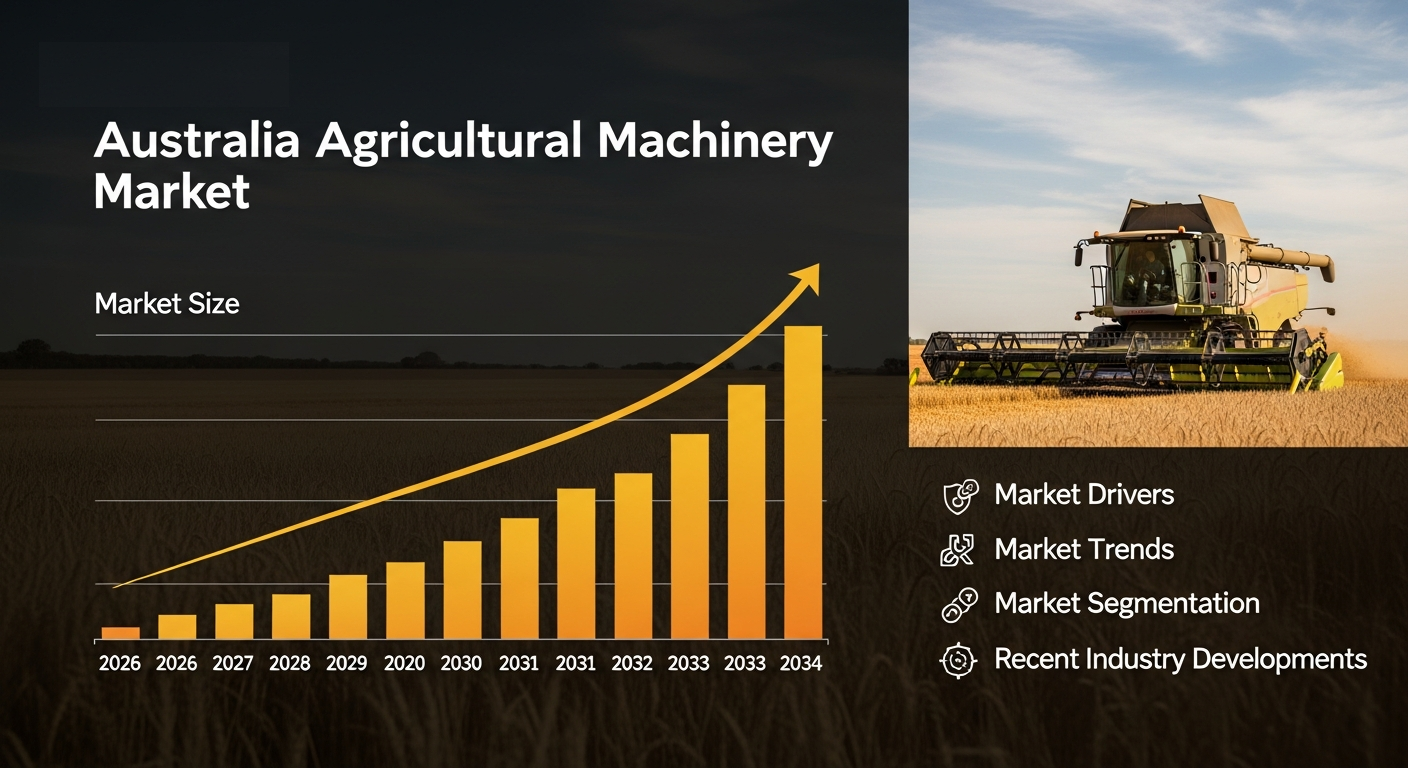
The Australian agricultural machinery market grew from USD 4.3 Billion in 2025 to USD 4.5 Billion in 2026. Looking forward, the market is expected to reach USD 6.5 Billion by 2034, exhibiting a growth rate (CAGR) of 4.77% during 2026-2034. The market is propelled by increasing demand for food and agricultural products, growing emphasis on sustainable farming practices, government policies and financial incentives, and rising adoption of smart technologies such as GPS guidance systems.
This market is strategically important to Australia's agricultural economy and food security landscape, supporting the country's position as a major global agricultural exporter with sophisticated mechanization requirements.
The Australian agricultural machinery market is poised for sustained expansion, underpinned by farm mechanization, precision agriculture adoption, and government support for ag-tech innovation. With a projected CAGR of 4.77% through 2034, the market presents significant opportunities for providers focusing on precision agriculture technologies, autonomous machinery, sustainable equipment, and digital connectivity solutions.
AUSTRALIA AGRICULTURAL MACHINERY MARKET SUMMARY
The Australian agricultural machinery marketes the provision of tractors, implements, and equipment designed to enhance agricultural productivity, efficiency encompassing, and sustainability across diverse farming operations.
The ecosystem spans global equipment manufacturers, regional distributors and dealers, precision agriculture technology providers, and financing equipment companies serving farmers across broadacre cropping, horticulture, and livestock operations throughout Australia.
By Product Type, the market is segmented into Tractors (dominating), Ploughing and Cultivating Machinery (Ploughs, Harrows, Cultivators and Tillers, Others), Planting Machinery (Seed Drills, Planters, Spreaders, Others), Harvesting Machinery (Mowers, Balers, Others), Haying Machinery, and Irrigation Machinery.
By Region, the market serves Australia Capital Territory & New South Wales (dominating), Victoria & Tasmania, Queensland, Northern Territory & Southern Australia, and Western Australia.
Key trends shaping the market include government policies and monetary benefits, rising demand for food, shift toward sustainable farming, precision agriculture adoption, automation and robotics, and telematics integration.
PORTER'S FIVE FORCES ANALYSIS – AUSTRALIA AGRICULTURAL MACHINERY MARKET
Competitive Rivalry: Moderate to High. The market features competition among global equipment manufacturers including John Deere, CNH Industrial, AGCO Corporation, Kubota Corporation, and Claas, alongside regional distributors and dealers. Competition centers on product innovation, precision agriculture capabilities, pricing strategies, dealer networks, and after-sales service. Business implication: Companies must differentiate through technological innovation, comprehensive dealer support, and application-specific solutions.
Supplier Power (Component and Technology Providers): Moderate. Manufacturers rely on suppliers of engines, transmissions, hydraulic systems, GPS and precision agriculture technology, and specialized components. The shift toward electric and autonomous machinery is increasing dependency on specialized technology providers. Business implication: Strategic partnerships and vertical integration can reduce supplier dependency while ensuring technological leadership.
Buyer Power (Farmers and Agribusinesses): High. Farmers and agribusinesses face volatile commodity prices and income uncertainty, making them price-sensitive and cautious about capital investments. Large-scale farming operations leverage volume purchasing power to negotiate favorable terms, while small and medium farms increasingly rely on leasing and rental options. Business implication: Providers must demonstrate value through productivity gains, operational efficiency, and flexible financing options.
Threat of Substitutes: Low to Moderate. Manual labor and traditional farming methods represent partial substitutes, though they are less efficient for large-scale operations. Equipment leasing and rental services provide alternatives to ownership, reducing capital requirements., mechanization remains essential for competitive agricultural production at scale. Business implication: Demonstrating superior productivity, efficiency, and cost-effectiveness is essential to maintain demand.
Threat of New Entrants: Low to Moderate. Significant capital requirements for manufacturing, technology development, dealer networks, and brand building create substantial barriers. However, the growth of precision agriculture, autonomous machinery, and digital platforms has enabled new entrants focused on specialized technology solutions. Business implication: Incumbents must leverage scale, technology leadership, and dealer relationships while monitoring emerging ag-tech innovators.
KEY ASPECTS REQUIRED FOR THE AUSTRALIA AGRICULTURAL MACHINERY MARKET
Market Performance: USD 4.3 Billion in 2025, projected to reach USD 6.5 Billion by 2034, driven by farm mechanization, precision agriculture, and government support.
Market Outlook: A 4.77% CAGR through 2034 reflects steady growth led by tractors, precision agriculture adoption, and large-scale farming expansion.
Growth Drivers: Increasing farm mechanization and technological advancement; rising agricultural production and export requirements; government support and financial incentives; rising demand for food; shift toward sustainable farming; precision agriculture adoption.
Competitive Landscape: A mix of global equipment manufacturers, regional distributors, and precision agriculture technology providers. Key players include John Deere, CNH Industrial, AGCO Corporation, Kubota Corporation, and Claas.
Value Chain Analysis: From component and technology sourcing through manufacturing, distribution, dealer networks, after-sales service, equipment financing, and digital platform integration across agricultural applications.
Industry Trends: Precision agriculture and GPS guidance; automation and robotics; sustainable and energy-efficient equipment; telematics and connectivity; autonomous machinery development; variable rate application systems.
Strategic Recommendations: Invest in precision agriculture and autonomous machinery technologies; develop sustainable and energy-efficient equipment offerings; expand telematics and connectivity capabilities; strengthen dealer networks and after-sales support; pursue government ag-tech innovation partnerships; target large-scale farming operations with high-performance machinery; develop digital platforms for remote monitoring and predictive maintenance.
Request for Sample Report: https://www.imarcgroup.com/australia-agricultural-machinery-market/requestsample
MARKET GROWTH DRIVERS
Increasing Farm Mechanization and Technological Advancement
The escalating adoption of farm mechanization across Australia's agricultural sector as a primary catalyst for machinery demand. With an average farm size of approximately 500 hectares, Australian farmers are increasingly investing in sophisticated equipment to optimize operational efficiency and reduce labor dependency. The integration of precision agriculture technologies, including GPS guidance systems, autonomous steering, and variable rate application systems, is transforming traditional farming practices. Modern tractors equipped with advanced features serve such as telematics, image sensors, and automated adjustments are becoming essential tools for contemporary agricultural operations. This technological revolution enables farmers to maximize productivity while minimizing resource waste, sustained driving investment in cutting-edge agricultural machinery throughout the country.
Rising Agricultural Production and Export Requirements
Australia's significant agricultural production growth, particularly in wheat, canola, and beef cattle sectors, is fueling substantial machinery investments. The country's role as a major agricultural exporter necessitates consistent production quality and efficiency to maintain competitive advantages in global markets. Favorable weather conditions with improved farming practices have resulted in higher gross values of agricultural production, creating stronger financial capacity for machinery procurement, which is further driving the Australian agricultural machinery demand coupled. The export-oriented nature of Australian agriculture requires farmers to adopt advanced harvesting, processing, and handling equipment that meets stringent international standards. These commercial imperatives drive continuous modernization of agricultural machinery fleets to ensure optimal product quality and operational reliability.
Government Support and Financial Incentives
Comprehensive government support through various schemes and financial incentives significantly accelerates agricultural machinery adoption across Australia. The Australian government actively promotes agricultural mechanization through subsidies, concessional loans, and tax benefits that reduce the financial barriers for farmers investing in modern equipment. Accelerated depreciation measures allow farmers to claim larger tax deductions for eligible machinery assets, making advanced technology adoption effectively viable. Programs such as the On-Farm Connectivity Program provide additional funding for ag-tech solutions that enhance productivity farming. growth by improving farmer access to capital and reducing investment risks associated with technological upgrades.
Rising Demand for Food
The increasing demand for food and agricultural products is another key factor driving the growth of the agricultural machinery market in Australia. According to the Australian Department of Agriculture, Fishery, and Forestry, a 2.1% annual increase in indicative food production occurred from $65 billion to $117 billion, a 2.3% annual increase in household food consumption expenditures occurred from $49 billion to $92 billion, and a 1.5% annual increase in net food exports occurred from $16 billion to $25 billion between 1988-89 and 2016-17 in Australia. As the population continues to grow, there is a tremendous need for food security, which puts pressure on the agricultural sector to enhance productivity. Australian farming are thus compelled to adopt more efficient practices and invest in machinery that can help maximize output. This includes machinery for tillage, planting, irrigation, and harvesting that is capable of handling larger-scale operations and improving crop yields. high standards and meet international demand. The need to boost both quantity and quality of produce is encouraging farmers to invest in advanced machinery that can streamline operations and reduce labor costs.
Shift Toward Sustainable Farming
A growing emphasis on sustainable practices is also driving the Australian agricultural machinery market share. As environmental concerns become more pronounced, there is a strong push toward reducing the ecological footprint of farming operations. According to the Australian Department of Agriculture, Fishery, and Forestry, many farms that practice broadacre cropping keep their stubble (85% of farms), minimize tillage (68% of farms), and maximize the use of fertilizer and herbicides while reducing their reliance on them (65% of farms). Besides, numerous livestock farms use a range of grazing management techniques, including rotational, trip, or cell grazing (61% of farms) and establishing a requirement for long-term groundcover (61% of farms). Modern agricultural machinery plays a crucial role in this transition by enabling more efficient use of resources such as water, fertilizers, and pesticides. Equipment that supports conservation tillage, precise irrigation, and targeted application of inputs helps minimize environmental impact while maintaining or enhancing productivity. Additionally, the demand for machinery that supports organic farming and other eco-friendly practices is on the rise.
Technology Integration and Connectivity Programs
The Albanese Government's expansion of the On Farm Connectivity Program represents a significant initiative supporting agricultural technology integration, with an additional $20 million allocated for Round 3 in 2025. This program specifically targets ag-tech connectivity solutions that enable farmers to optimize soil quality monitoring, automate livestock management systems, and safeguard farming equipment through advanced monitoring technologies. The initiative demonstrates government commitment to bridging digital divides in rural areas while promoting smart practices that require sophisticated agricultural machinery. These connectivity-focused farming programs create essential infrastructure foundations that support the deployment and operation of modern, connected agricultural equipment.
AUSTRALIA AGRICULTURAL MACHINERY MARKET SEGMENTATION
Segmentation analysis provides a detailed view of the Australian agricultural machinery market by category:
Product Type Insights: Tractors dominate the Australian agricultural machinery market, serving as the foundational power source for diverse farming operations including land preparation, planting, spraying, and hauling. Tractors range from compact utility models for small farms to high-horsepower machines for large-scale broadacre operations. In August 2024, John Deere announced significant improvements to its popular 6M tractor series for Model Year 2025, expanding the range to include thirteen models with increased speed and power capabilities. The enhanced lineup now features four models exceeding 200 horsepower with 50 kph transmission systems, addressing the growing for high-performance agricultural machinery in Australia's diverse farming operations. Ploughing and cultivating machinery represents a significant segment, encompassing ploughs, harrows, cultivators, and tillers used for soil preparation and seedbed. Planting machinery constitutes a major segment, including seed drill conditioning, plant demand conditioning, and spreaders designed for precise seed placement and fertilizer application. Harvesting machinery represents a critical segment, with mowers, balers, and combine harvesters essential for efficient crop collection and processing. Haying machinery serves livestock operations, while irrigation machinery supports water management for crop production.
Regional Insights: Australia Capital Territory & New South Wales represent a significant regional market, with diverse agricultural activities including grain production, livestock, horticulture, and dairy farming. The region benefits from established infrastructure, proximity to major markets, and a concentration of agricultural service providers. New South Wales' extensive grain belt drives for tractors, harvesters, and precision agriculture equipment. and subtropical agriculture including sugarcane, cotton, and horticulture driving demand for specialized equipment. Northern Territory & Southern Australia collectively contribute to the market, with extensive livestock operations, grain production, and emerging agricultural development. Western Australia is a major agricultural region, with extensive grain production, livestock operations, and broadacre farming driving demand for high-capacity equipment.
COMPETITIVE LANDSCAPE
The competitive landscape of the Australian agricultural machinery market features a mix of global equipment manufacturers, regional distributors, and precision agriculture technology providers. Global players including John Deere, CNH Industrial, AGCO Corporation, Kubota Corporation, and Claas maintain strong positions through product innovation, dealer networks, and brand recognition. Regional distributors and dealers compete through localized service, competitive pricing, and customer relationships. Precision agriculture technology providers are increasingly important, offering GPS guidance, autonomous systems, and digital platforms that enhance equipment productivity and efficiency.
John Deere is a leading global agricultural equipment manufacturer with significant presence in the Australian market. The company offers a comprehensive portfolio of tractors, harvesters, and precision agriculture technology, leveraging strong brand recognition, dealer networks, and technological leadership. In August 2024, John Deere announced improvements to its popular 6M tractor series for Model Year 2025, expanding the range to include thirteen models with increased speed and power capabilities.
CNH Industrial operates in the Australian agricultural machinery market through its Case IH and New Holland brands, offering tractors, harvesters, and implements across diverse farming applications.
AGCO Corporation maintains presence through its Fendt, Massey Ferguson, and Valtra brands, providing tractors, harvesters, and precision agriculture solutions for Australian farmers.
Kubota Corporation is a major player in the Australian market, offering tractors, implements, and specialized equipment for horticulture, viticulture, and compact farming applications.
Claas is a leading harvester manufacturer with significant presence in the Australian market, offering combine harvesters, balers, and forage equipment for grain and livestock operations.
Regional distributors and precision agriculture technology providers are increasingly important, offering GPS guidance, autonomous systems, and digital platforms that enhance equipment productivity and sustainability.
Renatural Developments:
August 2024: John Deere announced significant improvements to its popular 6M tractor series for Model Year 2025, expanding the range to include thirteen models with increased speed and power capabilities. The enhanced lineup now features four models exceeding 200 horsepower with 50 kph transmission systems, addressing the growing demand for high-performance agricultural machinery in Australia's diverse farming operations.
2025: The Albanese Government expanded the On Farm Connectivity Program with an additional $20 million allocated for Round 3, supporting ag-tech connectivity solutions.
Investment opportunities exist in precision agriculture technologies, autonomous machinery, sustainable equipment, and digital connectivity solutions.
REGIONAL ANALYSIS
Australia Capital Territory & New South Wales represent a significant regional market within the Australia agricultural machinery sector, with diverse agricultural activities including grain production, livestock, horticulture, and dairy farming. The region benefits from established infrastructure, proximity to major markets, and a concentration of agricultural service providers. New South Wales' extensive grain belt, including the Riverina and Liverpool Plains, drives demand for tractors, harvesters, and precision agriculture equipment.
Victoria & Tasmania constitute a major agricultural region, with intensive horticulture, dairy, and grain production supporting demand for diverse machinery types. Victoria's dairy industry, one of Australia's largest, drives for tractors, forage equipment, and irrigation systems. The region's horticultural sector supports demand for specialized planting, spraying, and harvesting equipment.
Queensland represents a significant market, with tropical and subtropical agriculture including sugarcane, cotton, and horticulture driving demand for specialized equipment. The state's extensive sugarcane industry requires specialized harvesters and haulout equipment. Cotton production in southern Queensland drives demand for precision planters, sprayers, and harvesters.
Northern Territory & Southern Australia collectively contribute to the market, extensive with livestock operations, grain production, and emerging agricultural development. The Northern Territory's cattle industry drives demand for equipment supporting pasture management, livestock handling, and fodder production. Southern Australia's grain production and mixed farming operations support demand for tractors, harvesters, and seeding equipment.
Western Australia is a major agricultural region, with extensive grain production, livestock operations, and broadacre farming driving demand for high-capacity equipment. The state's wheat belt, one of Australia's largest grain-producing regions, requires high-horsepower tractors, combine harvesters, and precision seeding equipment. The region's livestock operations support demand for forage and pasture management equipment.
RECENT INDUSTRY DEVELOPMENTS
2026 Activity: The Australian agricultural machinery market continued its growth trajectory from USD 4.3 Billion in 2025 to USD 4.5 Billion in 2026 toward USD 6.5 Billion by 2034 at a CAGR of 4.77%.
August 2024: John Deere announced significant improvements to its popular 6M tractor series for Model Year 2025, expanding the range to include thirteen models with increased speed and power capabilities.
2025: The Albanese Government expanded the On Farm Connectivity Program with an additional $20 million allocated for Round 3, supporting ag-tech connectivity solutions.
FREQUENTLY ASKED QUESTIONS
Q1: What is the current size of the Australian agricultural machinery market?
A: The Australian agricultural machinery market grew from USD 4.3 Billion in 2025 to USD 4.5 Billion in 2026 and is projected to reach USD 6.5 Billion by 2034, exhibiting a CAGR of 4.77% from 2026-2034.
Q2: What are the key drivers of the Australian agricultural machinery market?
A: The market is driven by: (i) increasing farm mechanization and technological advancement; (ii) rising agricultural production and export requirements; (iii) government support and financial incentives; (iv) rising demand for food; (v) shift toward sustainable farming; and (vi) precision agriculture adoption.
Q3: What are the major product types in the Australian agricultural machinery market?
A: Major product types include Tractors (dominating), Plowing and Cultivating Machinery, Planting Machinery, Harvesting Machinery, Haying Machinery, and Irrigation Machinery.
Q4: Which region leads the Australian agricultural machinery market?
A: Australia Capital Territory & New South Wales represents a significant regional market, with diverse agricultural activities including grain production, livestock, horticulture, and dairy farming.
Q5: Who are the major players in the Australian agricultural machinery market?
A: Major players include John Deere, CNH Industrial, AGCO Corporation, Kubota Corporation, and Claas, among others.
Q6: What are the challenges facing the Australian agricultural machinery market?
A: Key challenges include high upfront costs of advanced machinery, shortage of skilled operators and technicians, volatility in commodity prices, supply chain disruptions, and the need for continuous technological adaptation.
Q7: What is the outlook for the Australian agricultural machinery market?
A: The market is projected to grow at a 4.77% CAGR through 2034, with growth driven by farm mechanization, precision agriculture adoption, and government support for ag-tech innovation. The shift toward autonomous machinery, sustainable equipment, and digital connectivity solutions are expected to shape the market's evolution.
Note: If you need any specific information that is not covered currently within the scope of the report, we will provide the same as a part of customization.
https://www.imarcgroup.com/request?type=report&id=24658&flag=E
Report Format, Delivery, and Customization Details
Report Format Mode: PPT, PDF, and Excel
Report Delivery Mode: Online Delivery, Physical Delivery
Report Delivery Time: Report Delivered Over Email within 24 to 48 hours. If requested by the client, a physical copy will be delivered within three to ten days.
Report Confirmation Mode: Yes via Email
Report Customization Mode: Yes via Email / Call
Report Table of Content: Yes
Report List of Figures: Yes
Report Methodology Mode: Yes
Request For Sample Report: Yes
Zero Press のデータで見るこのリリース
- 配信
- Zero Press から配信
- カテゴリ
- その他
- 直近 7 日の配信
- その他 205 本 / 全体 11,384 本
Zero Press が取り込んだ配信データから自動集計しています。カテゴリ別・業界別のより詳しい分析は週間動向レポートで毎週公開しています。
このジャンルのリリースを書くときのガイド

このリリースの配信元
B2B Market Report
企業概要・過去のリリース・提供資料は企業ページでご覧いただけます。
-

街角コレクション、スポットのコレクションページにXとLINEのシェアボタンを追加。先駆者スポッターの表示や写真まとめツールの画質向上も
ぷれりり掲載リリース
-

東京都だけで2,722件。トイレつまり・水漏れ時に「近くの水道業者へ直接電話できる」無料ディレクトリ「DrainFind」を公開
codelumix
-

【名城大学・女子駅伝部】名城大学×名城大学附属高校「高大連携」で切り拓く女子駅伝の新たな未来!
学校法人 名城大学
-

【整形外科医解説】その「すり傷」消毒して乾かすのは間違い?跡を残さない正しい応急処置と受診のサイン
まえだ整形外科リウマチクリニック
-

株式会社大塚貴彦事務所が合気柔術協会™を商標出願いたしました
株式会社大塚貴彦事務所
-

海外旅行向けデータ容量診断サイト「TabiGB」、20渡航先のeSIM情報ページに国別解説と写真を追加
ぷれりり掲載リリース
-

Raipt、札幌の法人向け印刷物・販促物配送の相談案内を公開
株式会社Raipt
-

【完全無料・登録不要】家族の介護負担を軽減する『介護パートナーサポートアプリ』を公開
ぷれりり掲載リリース
-

成人式まるごとおまかせ!振袖専門店 「キモノハーツ東京/錦糸町」グランドオープン
ぷれりり掲載リリース
-

容積式ギアポンプの世界市場(2026年~2032年)、市場規模(内歯車ポンプ、外歯車ポンプ)・分析レポートを発表
株式会社マーケットリサーチセンター
-

パイプチェーン搬送システムの世界市場(2026年~2032年)、市場規模(粉末材料、粒子状材料、ブロック状材料)・分析レポートを発表
株式会社マーケットリサーチセンター
-

ポリイミド前駆体の世界市場(2026年~2032年)、市場規模(PMDA-ODA型、BPDA-PDA型、ODPA-ODA型)・分析レポートを発表
株式会社マーケットリサーチセンター